
East Honolulu Directory Collection Map
Hawaii's city directory shelf has a long, traceable sequence. The publications are usually labeled for Honolulu, the Territory, the City and County, or the Hawaiian Islands, not for the modern East Honolulu CDP. The table separates the publishers, year runs, and access points documented by the State Archives and University of Hawaii.
| Collection | Years represented | Where held | Access |
|---|---|---|---|
| Thrum's Hawaiian Annual and Standard Guide | 1875–1974; name index 1875–1932 | UH Special Collections | Reference and microfilm |
| Kingdom statistical and commercial guide | 1880–81 | State Archives and UH | Historical holdings and linked scans |
| McKenney and Hawaiian directory runs | 1884–85 and 1888–92/93 | Archives, UH, FamilySearch | Hard copy, scans, microfilm |
| Husted directories | 1894–1910 | Archives, UH, FamilySearch | Selected online scans and film |
| Polk-Husted Honolulu and Territory | 1911–1929/30 | UH and Archives | Microfilm and hard copy |
| Polk-Husted City and County | 1930/31–1940/41 | UH and Archives | Repository access |
| Polk and later island directories | 1941/42 through 1987 | UH and Archives | Microfilm, microfiche, hard copy |
The State Archives links selected volumes for 1880–81, 1884–85, 1888–90, 1892, 1894–98, 1902–06, 1910, 1913, and 1924. Availability varies by repository, so confirm the exact volume before a visit or citation.
East Honolulu City Directory Shelf
The Hawaiʻi State Archives city-directory page is the main inventory and scan gateway. Hard-copy Polk and Husted volumes are held at the Kekāuluohi Building on the ʻIolani Palace Grounds, 364 South King Street, Honolulu 96813. The public hours listed are Monday through Friday, 9 a.m. to 4 p.m., with weekends and holidays closed. The phone is 808-586-0329.
The captured inventory shows how the archive describes its city directory holdings and routes readers to digital volumes.
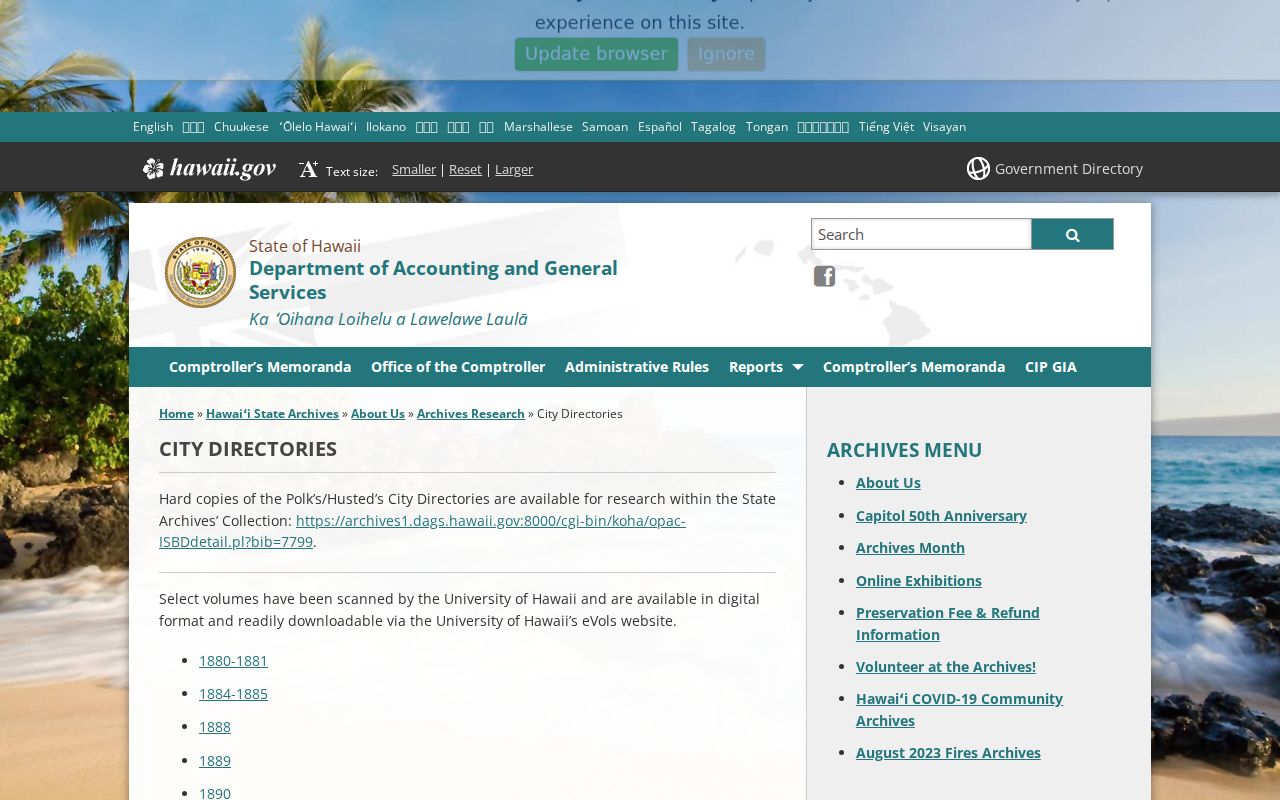
In-person access matters because not every year is digitized. Ask for a precise publisher and year. When the desired year is absent, consult adjacent years rather than treating the gap as proof that a person or address was absent.
Husted and Polk in East Honolulu
The publisher sequence records major political and geographic shifts. An 1880–81 kingdom guide precedes McKenney's 1884–85 Honolulu section. Hawaiian directory and handbook titles bridge the late 1880s and early 1890s. Husted takes over the best-known run in the mid-1890s, with Honolulu and Hawaiian Territory titles through 1910. Polk-Husted then covers Honolulu and the Territory into 1929/30, followed by City and County wording and later Polk island volumes.
The UH Hawaiian genealogy bibliography supplies call numbers and format details, including HAWN DU621 .P6, microfilm S51152 for 1902–1935/36, and later microfiche. Its captured page is a finding aid for planning shelf or film work.
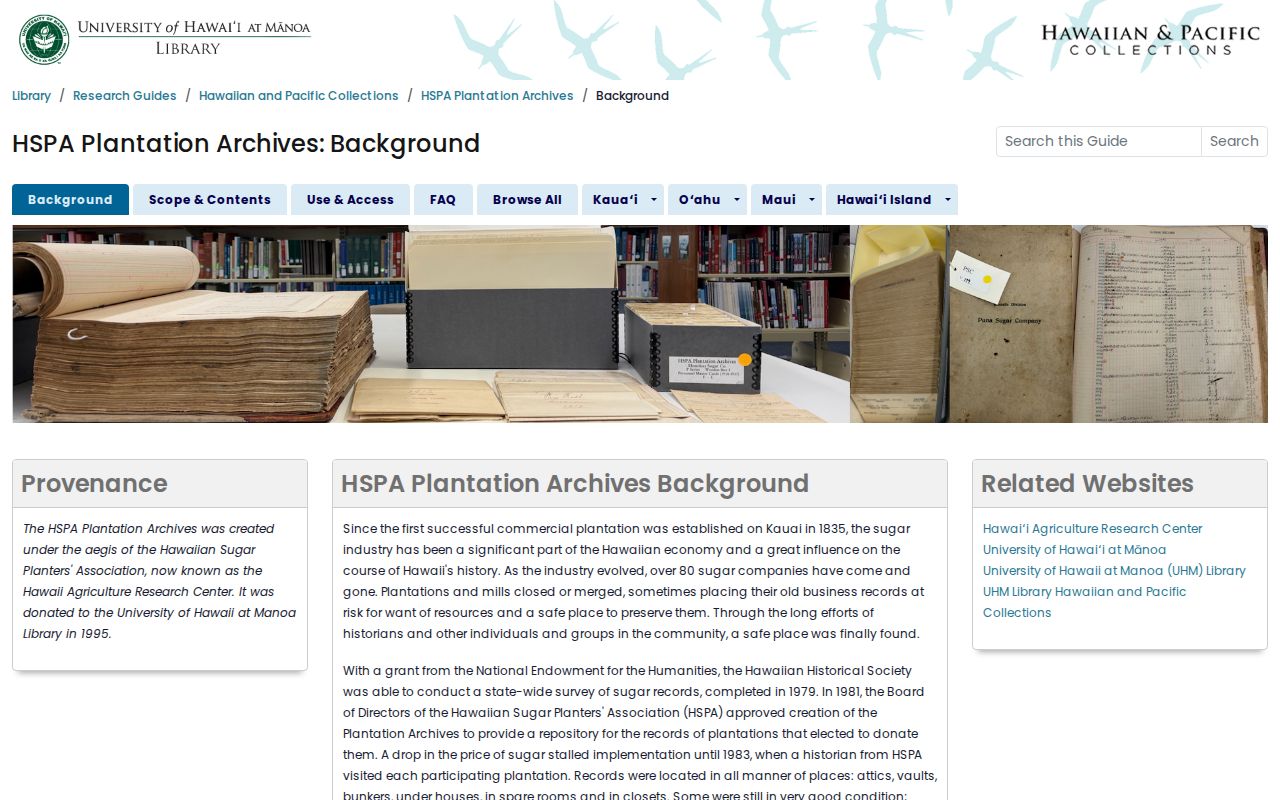
Publication year is evidence, not upload date. Record the title printed in the volume, publisher, stated year, page or image number, repository, and access date.
Read an East Honolulu Entry
The 1900 Husted scan illustrates a source architecture rather than a modern search form. Personal entries may combine a printed name, initials, occupation or business, and a residence. Separate classified business and street sections can point to the same person or place from another angle. OCR can miss worn type, Hawaiian spelling, initials, and abbreviations, so the page image controls.
| Printed name | Preserve initials, titles, spelling, and diacritics as shown. |
|---|---|
| Occupation or business | Copy the line; expand abbreviations only in notes. |
| Address | Mark whether the text indicates a home, room, office, or business. |
| Cross-reference | Record the street or classified section and page. |
| Status wording | Copy terms such as widow only when printed; do not infer a modern relationship. |
| Citation | Save volume, year, page or image, repository, URL, and access date. |
One line can contain both a useful clue and an easy mistake. A business location is not automatically a residence. Likewise, two people with the same initials should remain separate until another record links them.
East Honolulu Directory Language
Later indexes and older type conventions use terms that can change how an entry is read. Consult the volume's own key before expanding any mark.
- Criss-cross directory
- A street-order section that lets a reader start with an address rather than a surname.
- Householder index
- A list organized around the named person associated with an address; it is not proof of everyone in the household.
- Abbreviation key
- The publisher's explanation of short forms for residence, rooms, occupations, firms, and status. Its meaning controls over a modern guess.
- OCR
- Optical character recognition, the machine-made text layer used to search a scan. Always verify it against the printed image.
Photograph or cite the abbreviation page before transcribing many entries. That small step keeps the city directory record faithful to its own publishing system.
Digital East Honolulu Directory Leads
The FamilySearch catalog lists 18 reels of 35mm film, including 1884 McKenney, 1890 Lane, 1892 and 1898 Husted, the 1900–01 News Publishing volume, and Husted years through 1907. The separate 1900 Husted book is an 858-page scan owned by the State Archives. Some FamilySearch images may require a free account or FamilySearch Center, and copyright can limit access.
UH's Hawaii-related research resources add the Hawaii Newspaper Index, Bob Krauss Research Index, Ulukau, and historic newspaper guides. These tools help check a name, organization, or address found in a directory.
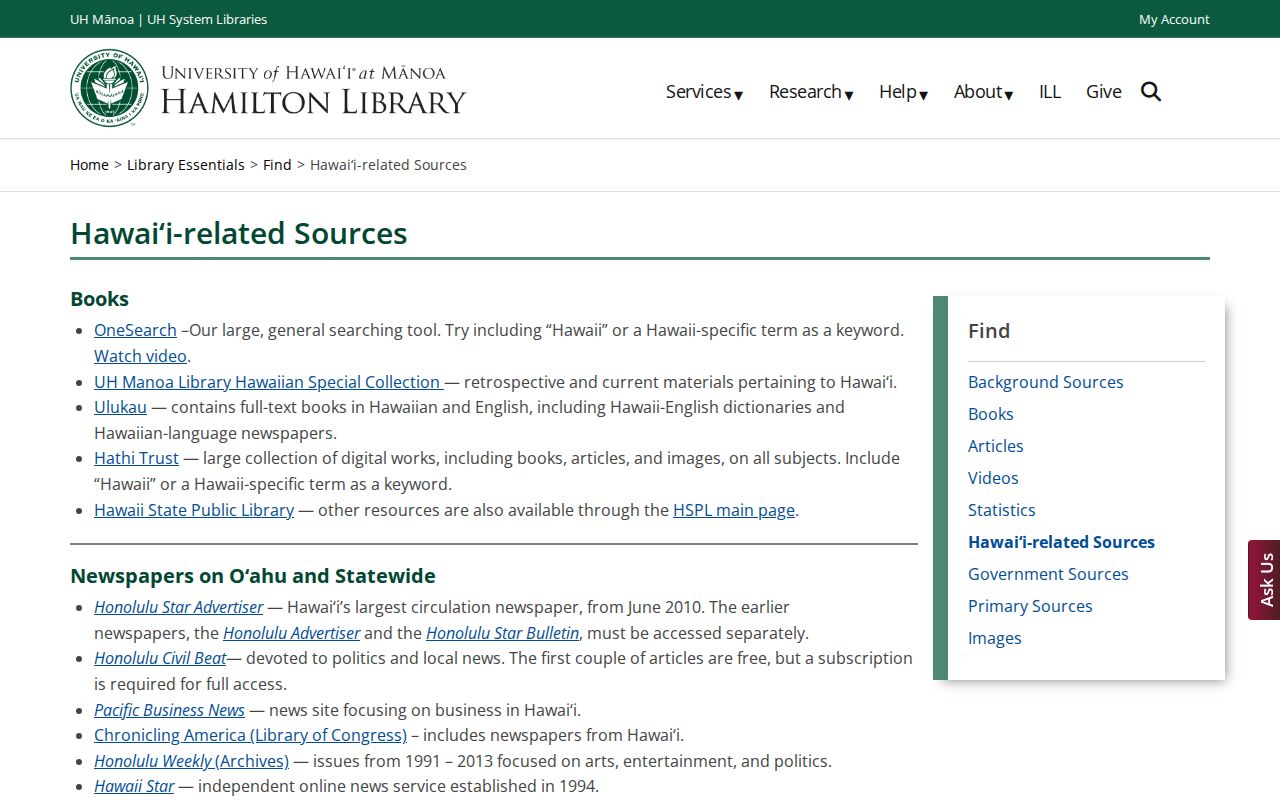
UH Hawaiian and Pacific Collections also holds reports, papers, maps, and local history in closed stacks. Items requested through OneSearch are generally made available in about 15 minutes, though the catalog remains a selected representation of the full collections.
Older Honolulu Is Not East Honolulu
East Honolulu is a modern Census-designated place, not an incorporated city. Historical city directories often use Honolulu, Koolaupoko, Maunalua, Waikīkī, or another older place label. In the nineteenth and early twentieth centuries, present-day East Honolulu land could be rural, ranch, fishpond, truck-farming, or beyond a directory's practical urban coverage. A name missing from the Honolulu pages is not proof that nobody lived there.
The landscape changed sharply after 1959, when Kuapa Fishpond was dredged and the Hawaiʻi Kai marina and peninsula system took shape. Modern streets and parcel lines may not align with older shore maps. Kalanianaʻole Highway, completed in 1932, provides a more durable address spine, but even that road crosses current neighborhood and ZIP labels.
Note: Preserve the historical place name as printed, then add a separate note explaining its possible relationship to the modern East Honolulu boundary.
East Honolulu Census Gaps Matter
Territorial census schedules cannot fill every directory year. State Archives holds incomplete returns for 1866, 1878, 1890, and 1896. The 1878 Oʻahu schedule does not cover the East Honolulu side. The 1890 material includes only limited Koolaupoko locations, while 1896 surviving material focuses on a few Honolulu streets. Those omissions are a historical finding.
Use later federal census resources from 1900, directory years on each side of a gap, deeds, probate, and newspapers. Do not invent continuity between two appearances. A family can move, a road can be renamed, a person can be unlisted, or a publication can skip a distant area.
Trace East Honolulu Family History
City directories work well between census years because each volume is a dated snapshot. Their strongest use is a careful sequence, not a single isolated line.
- Choose a name, organization, street, or business and define a reasonable year range.
- Open the exact directory year, inspect the image, and copy the entry without silently expanding marks.
- Check the classified and street sections to distinguish a residence from a business address.
- Compare the year before and after, then pair the sequence with the closest available census.
- Check the State Archives obituary index, probate, newspaper, land, or vital index for independent support.
The obituary index covers 1836–1950, mainly English-language Honolulu newspapers. A newspaper item should be cited by title, date, and page. It adds context but does not turn an old address into a current residence.
Local East Honolulu Research Stops
Aina Haina Public Library, opened in 1962, offers computers, periodicals, newspapers, Wi-Fi, meeting rooms, and copying at 5246 Kalanianaʻole Highway. Hawaii Kai Public Library, opened in 1973, offers similar tools at 249 Lunalilo Home Road. These branches are practical access points, though the research found no dedicated East Honolulu house-history collection at either branch.
For actual historical holdings, use State Archives, UH Special Collections, the State Library, or FamilySearch. Local librarians can help route catalog and newspaper questions. Keep repository access distinct from ownership of the source itself.
Use East Honolulu Directories Carefully
A city directory is not exhaustive. Entries can omit women, children, boarders, rural households, people who declined listing, and communities outside the publisher's route. Names can be misspelled. OCR can compound the error. Occupations and addresses can change before the next edition.
A safe historical citation reports only what the page shows and why it matters. It does not publish a modern private address, infer an unprinted relationship, or claim current residence. When a directory match needs present-day checking, use a defined official record and respect protected addresses and access limits.
Historical evidence. Treat each East Honolulu city directory entry as a dated lead and corroborate identity, place, and relationship with another source.